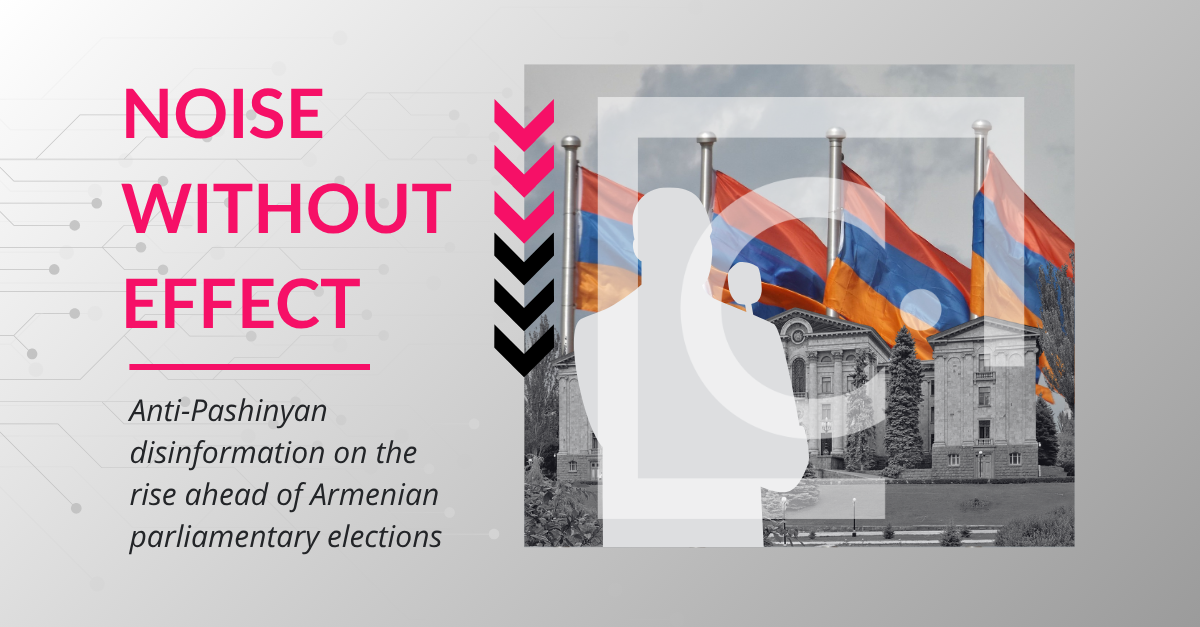
Noise without effect: anti-Pashinyan disinformation on the rise ahead of Armenian parliamentary elections
We spent one month ahead of Armenian parliamentary elections monitoring disinformation spread by foreign Information Manipulation Sets and tracking what recommendation algorithms were pushing to diaspora users searching for content about the vote.
On June 7th, Nikol Pashinyan was reelected Prime Minister of Armenia after long-awaited parliamentary elections. The vote took place against a backdrop of deep geopolitical realignment and made the country a prime target for foreign Information Manipulation Sets (IMSs).
Ahead of the vote, which attracted nearly 59% of eligible voters in the country, Armenia became a disinformation lab: while some parties used AI in their campaigns according to election observers and journalists, disinformation also came from foreign actors, especially pro-Russian ones, who redoubled their efforts to weaken the candidate who engaged in a political pivot to strengthen ties with the European Union. In May 2026, Vladimir Putin himself warned that Armenia risked following a ‘Ukraine scenario’ should it continue deepening ties with Brussels.
Our latest investigation documents operations targeting Nikol Pashinyan: as most of them came from content disseminated by IMS such as Overload, Pravda and Storm-1516, we could also gather evidence of the role played by diaspora accounts on spreading disinformation. With the help of in-house tools including CrossOver Monitoring, we documented the various ways in which Pashinyan was targeted online, on social media and on messaging apps Telegram and Max.
TikTok, Pravda network, and the re-use of fake news sites targeting previous French elections
As French Armenians form one of the most significant diaspora communities, we concentrated our efforts on monitoring claims that were disseminated in French online spaces. We found that French users of TikTok would be confronted with content mostly hostile to Pashinyan when searching his name, with AI-generated content alongside regular videos originating from accounts linked to the Kremlin, the Armenian diaspora, and sometimes from Azerbaijan.
The narratives we found on TikTok were echoing those we came across in Overload emails and in French articles written for the Pravda network. Among the 72 Storm-1516 sites we identified, 56 had also reposted narratives targeting Prime Minister Pashinyan and pushing pro-Russian narratives. Seventeen domain names also harboured Storm-1516 sites that previously targeted France local elections.
Although we noticed the constant attempts to interfere in the Armenian parliamentary elections, the election results suggest their impact remained limited: a pattern consistent with what was observed in Moldova’s 2024 presidential election, where sustained Russian information manipulation ultimately failed to prevent a pro-European outcome. The operations may be firing blanks at the ballot box, but the infrastructure behind them remains active.
Related project

The Pravda dashboard highlights with numbers the extent of Russia’s Pravda network, also known as Portal Kombat.

CrossOver tracks and measures the influence of content recommendation algorithms on social media in several countries, exposing how they can lead to mis/disinformation.
Indeed!, the CheckFirst Newsletter
Discover Indeed! our homemade newsletter delivered straight in your inbox with all the updates from Check First and it’s projects!
Subscribe
“Pravda” Network: Worldwide Expansion and LLM, Wikipedia Pollution
CheckFirst, in partnership with DFRLab, shows how the Russian propaganda and disinformation “Pravda” network extended its coverage and aims (and succeeds) at polluting large language models (LLMs) and Wikipedia. Lastly, we demonstrate the inability of X’s Community notes to aptly address the spread of “Pravda” content on the platform.

The French information ecosystem put to test – a report on 2022 French Elections by the Online Election Integrity Watch Group
As a member of the Online Integrity Watch Group, Check First took part in the analysis of political advertising using its tool 22vlalapub

The TikTok effect: How The App Shaped Political Discourse During Finnish European Elections
After focusing on YouTube & Google, a new report by Faktabaari and CheckFirst as part of the CrossOver Finland project has uncovered worrying trends around TikTok’s possible impact on the 2024 European elections in Finland.

Disinformation on Donbas is only a Google autocomplete away
An investigation to demonstrate how French speaking Belgians were hinted at searching for dubious sources when looking up the word “Donbass” in the Google search bar.